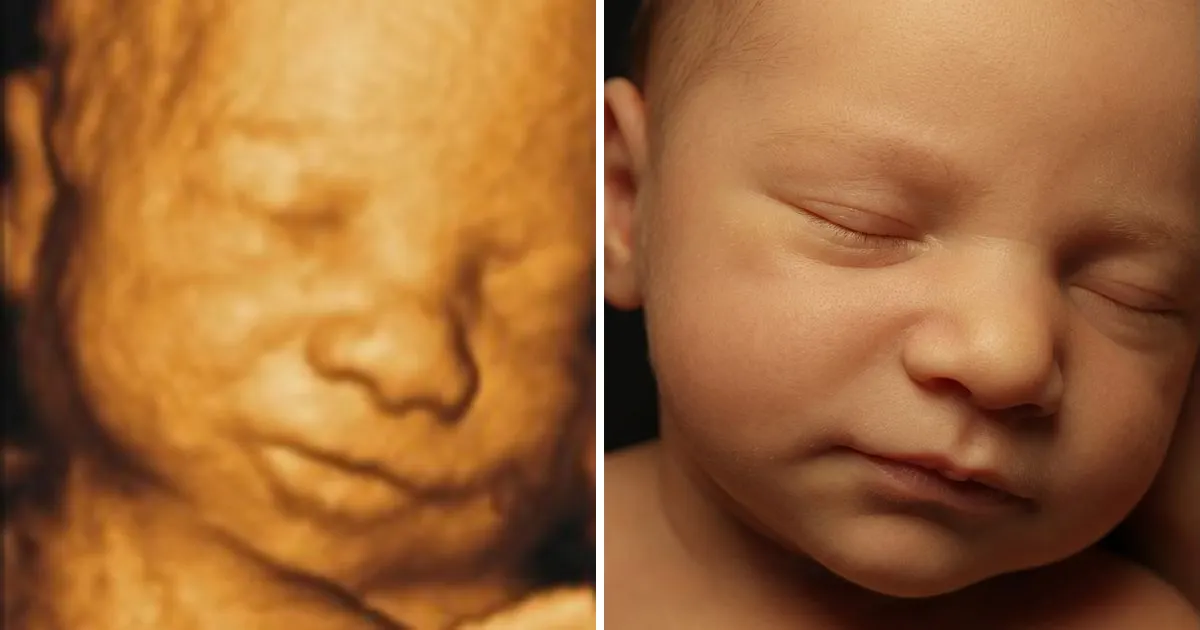
After seeing that little face in a 3D ultrasound, almost every parent asks the same question: “Will my baby look like this?” Social media is full of side-by-side pictures of 3D and 4D ultrasounds next to real newborns: some are uncanny, others not so much. In this article we explain what usually matches between a 3D ultrasound and the real baby, what changes at birth and why some scans are misleading.
Short answer: yes, with a few caveats
A clear 3D ultrasound taken between weeks 26 and 32 shows the real shape of your baby’s face: the nose, lips, cheeks and chin. That’s why so many parents recognize those features as soon as the baby is born. What the scan can’t show (skin tone, hair, open eyes) and the natural swelling of the first days are what change the impression the most.
What usually matches between the scan and the baby
| Feature | In a 3D ultrasound | At birth |
|---|---|---|
| Lips and mouth | Very visible, including the shape of the upper lip | Usually very similar |
| Nose shape | Visible, sometimes looks wider | Similar, slightly flattened for the first days |
| Cheeks and face shape | Visible from week 26 | Similar, usually fuller |
| Chin and jaw | Visible if there’s no hand in front | Similar |
| Ears | Only sometimes, depending on position | Similar when visible |
| Eyes | Closed | Open: a big change in expression |
| Skin tone and hair | Not visible (the color is a machine filter) | Only revealed at birth |
Why a baby sometimes looks different from the ultrasound
- The orange color is a filter. The machine uses that tone to make the image look more natural, but it has nothing to do with your baby’s skin.
- The baby is squeezed. Pressed against the placenta or the uterine wall, the face can look flattened or show odd shapes that don’t exist outside the womb.
- Birth changes the face for a few days. It’s normal for newborns to have puffy eyelids and a swollen nose and, after a vaginal birth, a slightly elongated head. Within a week or two everything settles.
- The week of the scan. A 22-week ultrasound shows a thin, bony face; babies are born much chubbier.
- Angle and quality. A face turned to one side, blurry or shadowed can fool even the parents.
- Babies change fast. A one-month-old face is different from a three-month-old face. The fairest comparison is with photos from the first weeks.
From ultrasound to realistic portrait
Between the ultrasound and the real baby there’s an in-between step that makes it much easier to picture: a hyperrealistic image. BabyFaceReveal starts from your 3D, 4D or 5D ultrasound and offers two kinds of results:
- 8K hyperrealistic enhancement: keeps the ultrasound look, with maximum definition and skin texture.
- Realistic portrait: turns the face in your scan into something close to a newborn photo, keeping the pose and proportions.
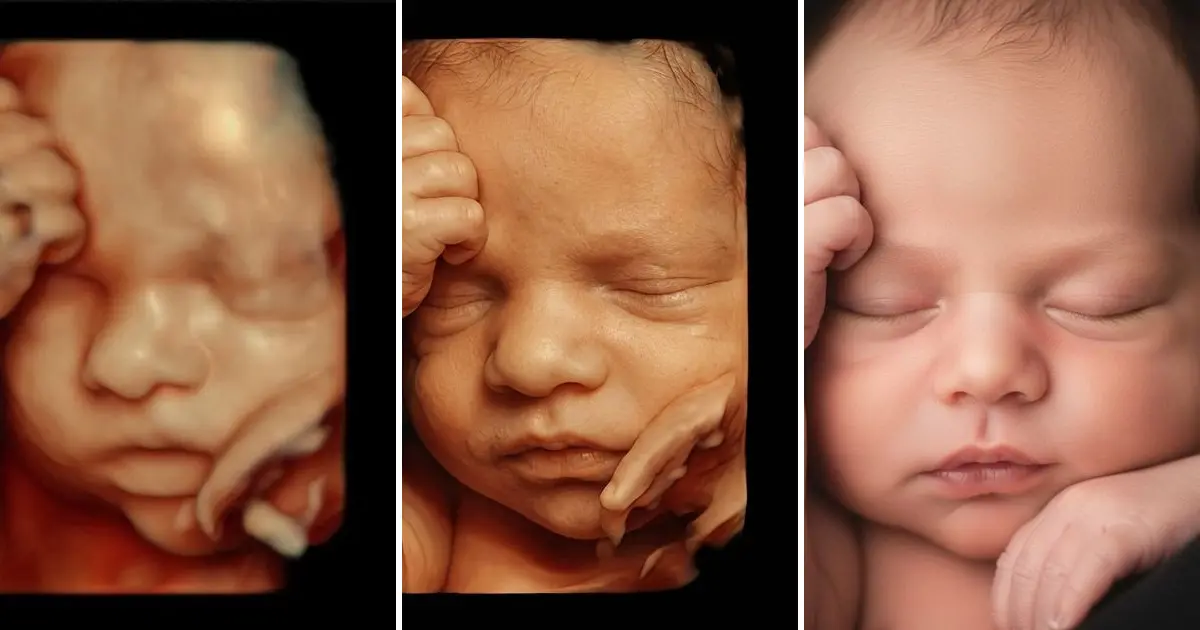
The cover image of this article shows all three steps for the same baby: the original ultrasound, the 8K enhancement and the realistic portrait. Keep in mind that it is a realistic interpretation of what the scan shows, not a medical or genetic prediction. Skin, eye and hair color can’t be known from an ultrasound.
See your baby before birth
Upload the 3D ultrasound you already have and get a hyperrealistic image of your baby’s face in about 30 seconds.
See my baby’s face →How to compare the scan with your baby after birth
If you want to make your own “ultrasound vs real baby” picture, a few tips make the comparison fairer (and the photo prettier):
For a comparison that makes sense
- Keep the original ultrasound file, not just a photo of the printout
- Wait two or three weeks, until the swelling from birth has gone down
- Photograph your baby asleep with eyes closed, like in the scan
- Use the same angle as the ultrasound (front, profile or hand on face)
- Choose soft, natural light
Can you tell who the baby will look like?
The ultrasound shows your baby’s face, but it can’t tell you whether that nose is dad’s or mom’s. Genetics gives clues, not certainties; we explain what can and can’t be predicted in what will my baby look like?
Curious about how the realistic image is made? Read how to see your baby’s face from an ultrasound with AI.