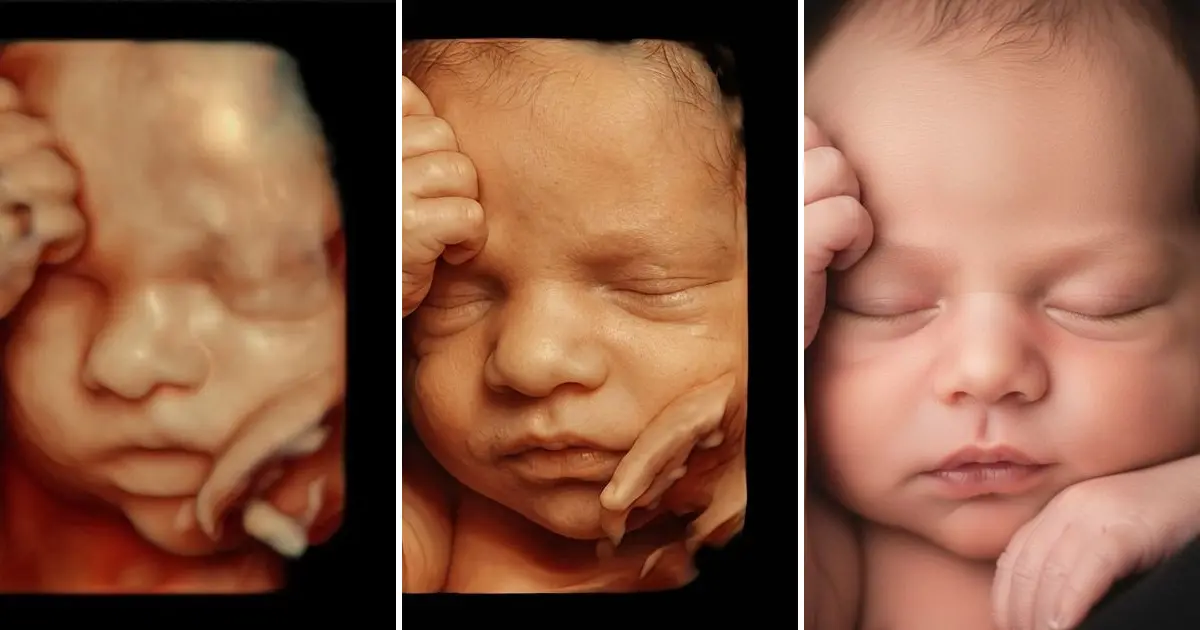
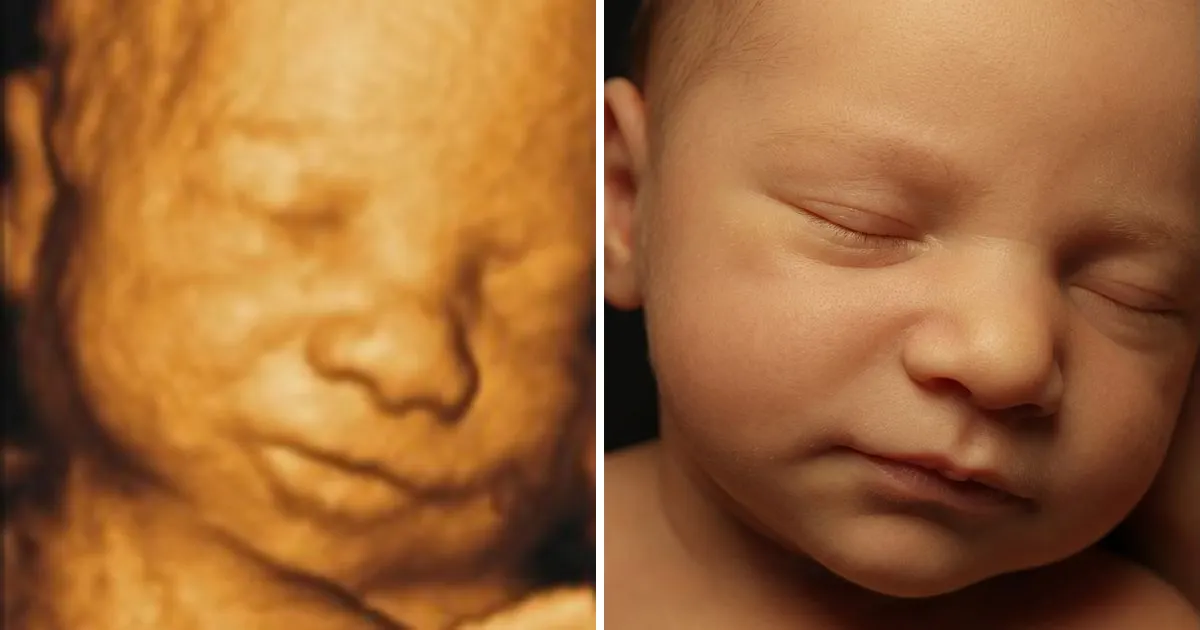
If you have ever held an ultrasound print and tried to make out your baby’s features, you know how hard it is. The grainy, high-contrast image gives you a glimpse — a nose here, a forehead there — but nothing close to what you will see the day they are born. Today, image technology can bridge that gap. There is one detail most parents don’t know before trying, though: not every tool handles ultrasounds well.
The short answer: yes, if the process is built for ultrasounds
AI can generate a photorealistic portrait of your baby from an ultrasound image. The technology exists and works. The key is that an ultrasound is a very particular kind of image, and getting a faithful result requires a process designed for it: one that recognizes the face through the noise of the scan and keeps the baby’s pose and proportions instead of inventing a different baby.
See your baby’s face in a realistic portrait
Upload the ultrasound you already have and see the difference in about 30 seconds.
Reveal my baby’s face →Why ultrasounds are different from normal photos
Ultrasound images are created by high-frequency sound waves bouncing off tissue, not by light. The result is full of acoustic artifacts, shadows and echoes that the human eye learns to read with practice. To turn that into a portrait, the process has to:
- Identify facial structures through the noise and grain of a prenatal scan
- Tell the forehead, nose bridge, lips and chin apart from acoustic artifacts
- Keep the exact position of the face, hands and cord visible in the scan
- Render that surface with realistic skin texture, lighting and soft tissue detail
This is a different problem from “generate a cute baby picture”, and it is why results vary so much from one tool to another.
What happens if you try with ChatGPT or a general AI?
You can upload an ultrasound to a general chatbot and ask for a photo. The usual problems are:
- It changes the baby. The pose, the shape of the nose or the position of the hands often don’t match the scan.
- It invents details where the scan is blurry, so the result looks like “a baby”, not like yours.
- Small images and limits: low resolution, usage limits and several attempts to get something usable.
A dedicated service such as BabyFaceReveal first checks that your image is a real ultrasound, applies instructions designed to keep the pose and proportions of your scan and delivers the result in high resolution, ready to download and print.
Which ultrasound gives the best result?
3D, 4D and 5D ultrasounds: best quality
Volumetric scans (3D, 4D and 5D) capture the surface of the baby’s face directly: the exact shape of the nose, the fullness of the cheeks, the curve of the lips. 5D scans in particular already look almost photographic, which gives the richest possible starting point. If you want to know more, read our guide on what a 5D ultrasound is.
The best window: weeks 26–32
Before week 26, facial features may not be fully formed. After week 32, the baby’s head often sits deep in the pelvis, making clear face images harder to capture. Weeks 26–32 are the sweet spot: features are defined and there is still enough amniotic fluid for a clear view.
Tips to get the best result
- Choose the clearest image you have. If you have several prints, pick the one where the face is most visible.
- Crop out measurement labels and printed text. Removing annotations helps the process focus on the face.
- A front-facing or slightly angled view works best. Pure side profiles give less facial detail.
- A photo of the printed scan is fine. Avoid reflections and take it straight on, with good light.
What the result actually reflects
The result is a photorealistic portrait generated from the facial structures visible in your scan: the shape of the nose, the proportions of the face and the pose as they appear in the ultrasound. It is not a genetic prediction or a blend of the parents’ features.
Many parents find the result surprisingly close to what they see at birth, especially around the nose and forehead. Think of it as a realistic preview grounded in your own scan. We compare scans and newborns in 3D ultrasound vs real baby.
“The nose is exactly the same as in the ultrasound. My husband cried when he saw the result.”
— Laura M., 27 weeks
“Seeing a real-looking photo of my baby before birth was one of the most emotional moments of my pregnancy.”
— Sofia R., 30 weeks
Why a specialized service is the right tool
The difference between a dedicated tool and a general one is not a minor detail: a general tool produces a decorative baby picture, while a process built for ultrasounds produces a portrait based on your scan.
BabyFaceReveal was built for exactly this: it works with the ultrasound you already have, keeps the pose of your baby and delivers a realistic portrait or an 8K hyperrealistic enhancement of the scan in about 30 seconds, from US$7.90.